Resolver Sovereignty: DNS4CN and China’s Resilient Internet Project
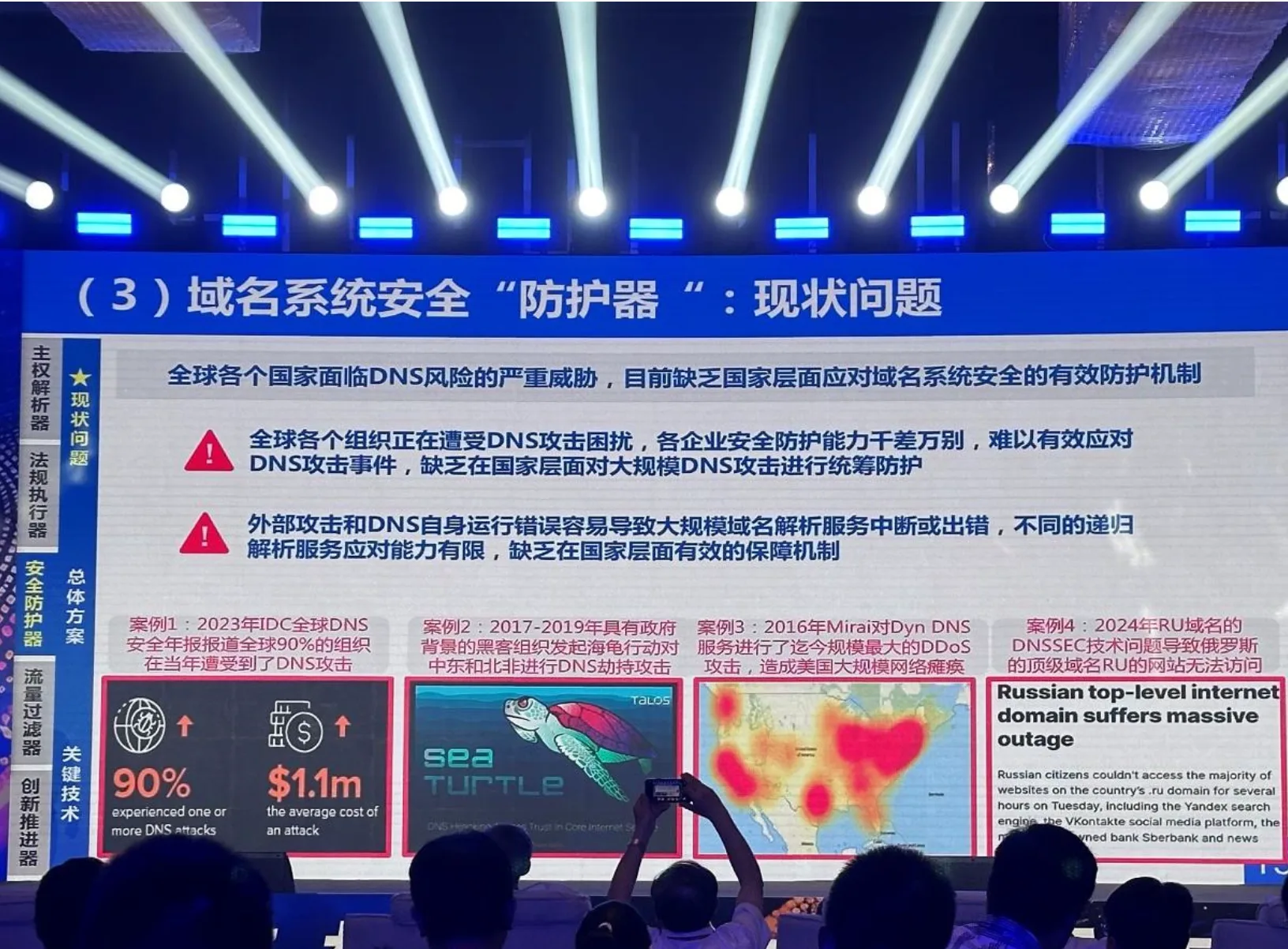
DNS4CN, like a lot of what spilled out of the September 2025 Geedge Networks and MESA Lab leak, reads at first like one more piece of censorship plumbing. The leak gave researchers (and the wider InfoSec and policy crowd) a rare look into the commercial supply chain behind the PRC’s domestic censorship apparatus and its export abroad, with documented deployments across Myanmar, Pakistan, Kazakhstan, and Ethiopia [cite: InterSecLab 2025]. Most of the reporting has followed that commercial trail (the products, the clients, the contracts), and for good reason. Comparatively little has gone to the academic and government layer beside it, where senior technologists and state-affiliated research institutes produce the research and system designs behind several of the products documented in the Geedge leak.
This piece focuses on DNS4CN, a proposed national DNS resolution system that Fang Binxing (the principal architect of the Great Firewall) presented publicly at the Third Next-Generation DNS Development Forum in Beijing in August 2024, a system that NetAskari first reported on.1
Fang described DNS4CN’s goal as building what he called 行使国家网络主权的大解析器 — a large-scale resolver that exercises national cyberspace sovereignty. The goal for DNS4CN is what Beijing calls 自主可控 — autonomous and controllable technology — this time pointed at the naming layer of the internet itself. The takeaway for readers should be clear: Splitting the internet along sovereign lines no longer requires cutting cables or pulling networks apart. It requires a resolver, and the question of what it resolves — for whom.
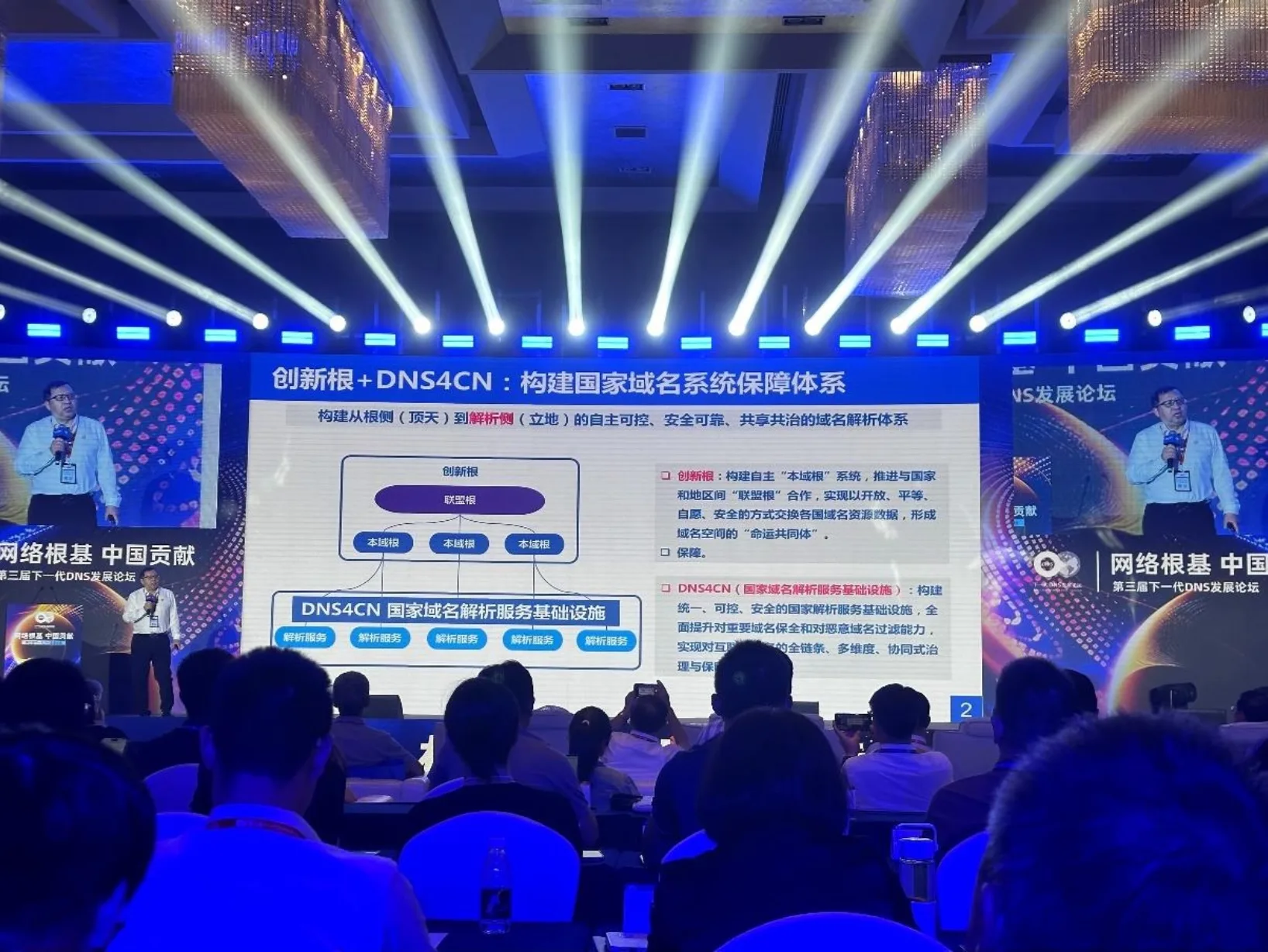
English Translation of the ZDNS post announcing DNS4CN
Regarding the overall architecture of the DNS4CN “large-scale resolver,” Academician Fang elaborated on three capability dimensions — classified/tiered service (分类服务), data interconnection (数据贯通), and unified management (统一管理) — and explained how these support business functions such as domain name preservation, compliance supervision, security protection, abuse governance, and new types of network innovation. Around the overall plan for DNS4CN, Academician Fang detailed the current problems, the overall solution, and the key technologies across three levels — technical, system, and business — and across the five aspects of “resolver,” “executor,” “protector,” “filter,” and “driver.” Academician Fang stated that building DNS4CN will have a stronger promoting effect on the overall security of the national network.2
Fang’s public announcement frames DNS4CN as modernization and national security.2 The leaked documents describe a control system. My three key judgments describe what the PRC is solving for and how DNS4CN is built to do it.
| # | Confidence | Domain | Summary |
|---|---|---|---|
| KJ1 | High confidence | Resolver consolidation | DNS4CN merges China’s 700,000+ fragmented resolvers into a single state-managed regime. Every query is logged (解析日志库), tied to a user identity and reputation score. Governance model shifts from managing information to managing users (管信息 → 管用户). |
| KJ2 | High confidence — design intent; capability undemonstrated | Deplatforming insulation | DNS4CN is designed to insulate China’s namespace from foreign deplatforming via a domain preservation function (域名保全) and an innovation root (创新根) outside ICANN, building toward self-circulation (自循环). A federated Alliance Root (联盟根) would extend this to aligned states. |
| KJ3 | High confidence (dependency, measured); design intent, deployment unknown (disruption) | Foreign-DNS dependency & disruption | DNS4CN is designed to cut China’s dependence on foreign DNS from both ends: reclaiming the 逆差 (resolution trade deficit), where ~20% of forwarding-DNS upstream and 24% of domestic DoH services route to foreign providers (Google, Cloudflare, OpenDNS), and disrupting the unauthorized encrypted DNS (DoH/DoT/DoQ) that routes around the national resolver via replacement-response (替代应答) at line rate. |
Notes on key people and institutions.
- CAS - China’s national Academy of Sciences. ~100+ research institutes under the State Council. This is the parent organization.
- IIE-CAS (Institute of Information Engineering, Chinese Academy of Sciences / 中科院信工所) - IIE is the institute within CAS dedicated to Information Security.
- MESA or MESA Lab (Massive & Effective Stream Analysis) - A specialty lab within IIE-CAS that specializes in large-scale network traffic analysis and encrypted-DNS measurement.
- Fang Binxing’s role - He currently chairs at Pengcheng Laboratory (PCL) in Shenzhen (a Guangdong/Shenzhen-funded provincial national lab) and serves as a PhD advisor at IIE-CAS, where he co-authors encrypted-DNS measurement research with MESA Lab. Principal Architect of the Great Firewall.
KJ1 - Resolver Consolidation and tie DNS queries to user identity
More than 99% of China’s 700,000-plus public resolvers are simple forwarding boxes with no real security and no central logging. The leak documents show that each ISP keeps its own records, or keeps none. The state has no single place to see what the country resolves, and fragmented resolvers filter inconsistently, letting potentially unwanted traffic through. This is obviously problematic for censorship of Chinese netizens, but it also lacks identity concepts and interception is left to individual ISPs.
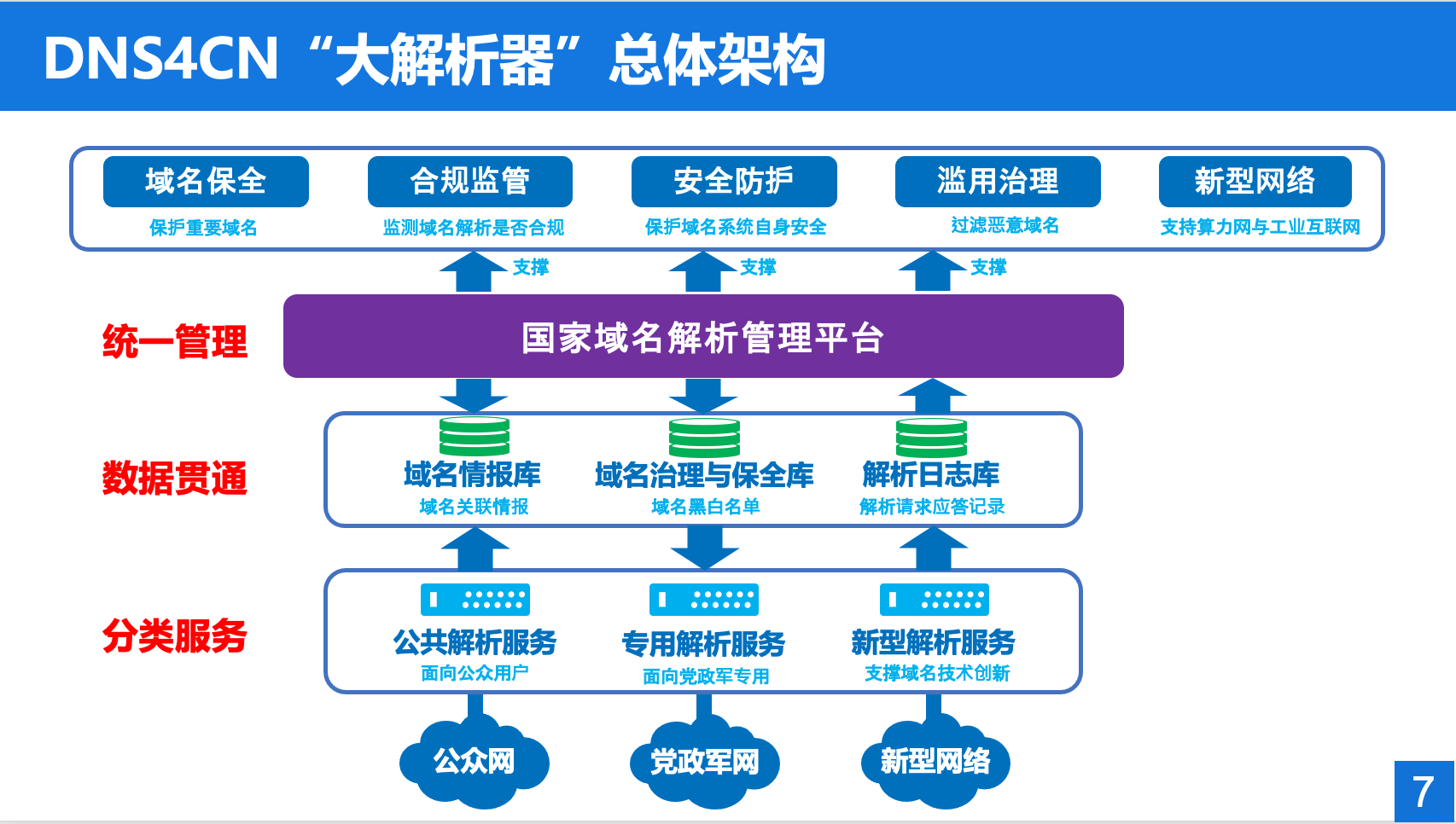
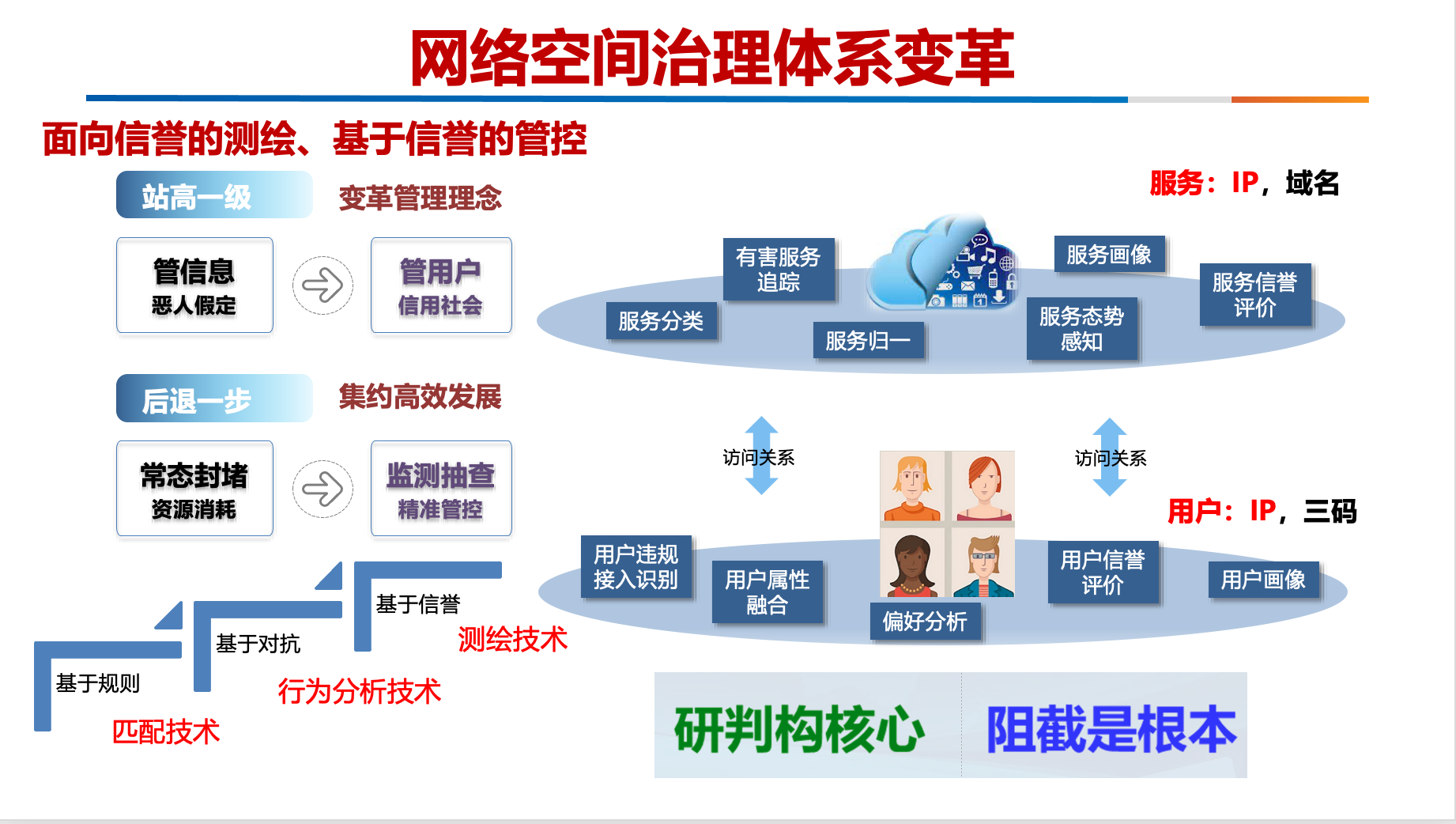
Together the two slides describe a system that logs every query, ties it to a user, and acts on the result. The vocabulary is security and compliance. The mechanism is social control, running on the DNS layer. Note the bottom right (研判构核心 阻截是根本) which means “analysis is the core, interception is the foundation.”
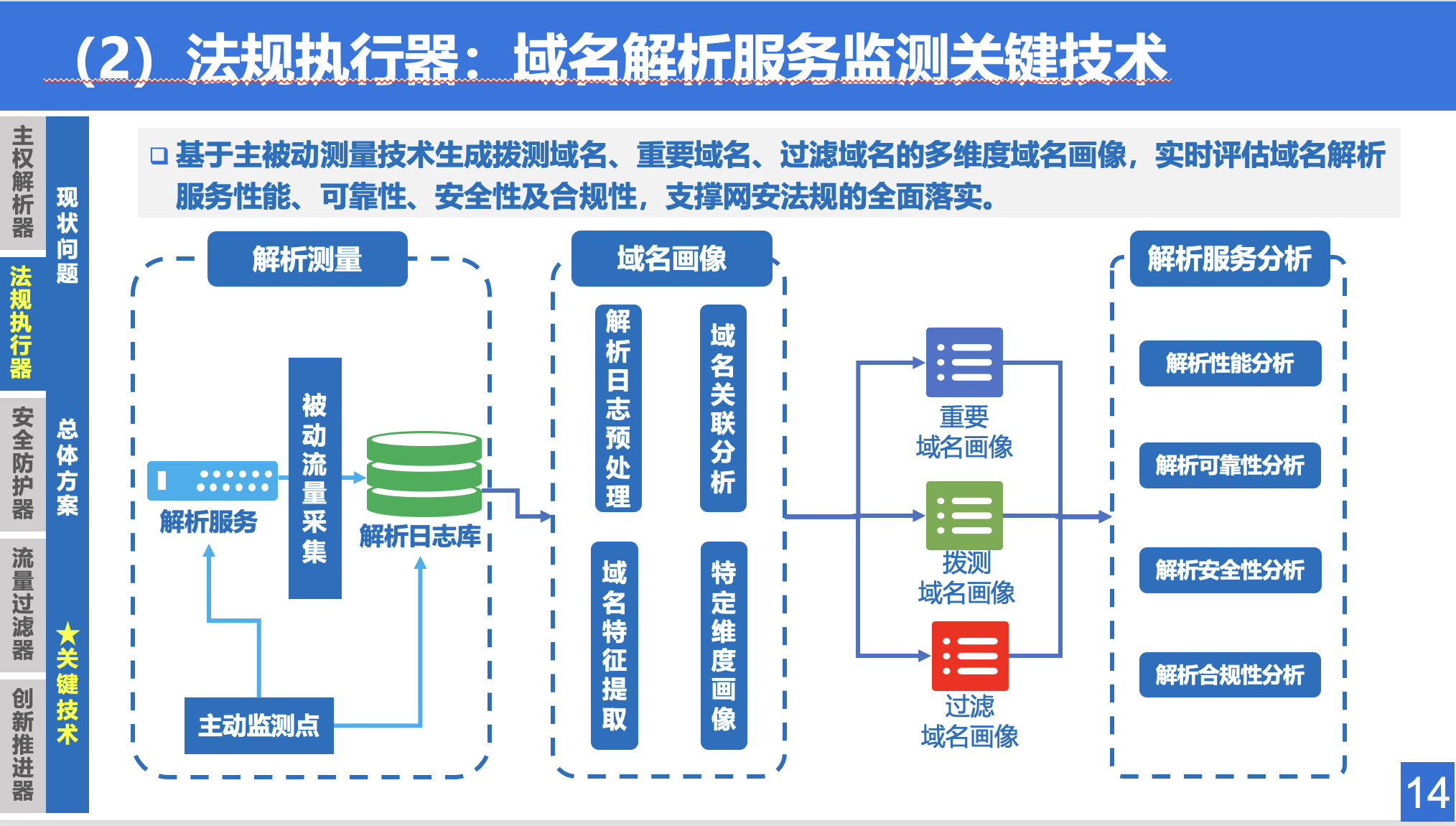
The architecture centralizes the logging point (Fig 1). The governance philosophy names the intent (Fig 2). The pipeline converts that intent into domain profiles and compliance scores (Fig 3). Analysis is the core, interception is the foundation (研判构核心 阻截是根本).
Consolidation solves the visibility and interception problem. However, China’s dependency on foreign root infrastructure for the namespace remains.
KJ2 - Deplatforming\Geopolitical insulation \ Federate root nameservers
This dependency is the most interesting thing about DNS4CN geopolitically. China cannot fully control how its own domains resolve, because the root and the authoritative chain above its resolvers sit outside its reach. DNS4CN’s second goal is to close that gap in two layers: a defensive one that keeps important domains resolving through foreign takedown attempts, and an aspirational one that aims to run the namespace even when cut off from the global root.
Fang’s deck states the problem as sovereignty: many of China’s important domains sit under generic TLDs, the resolution path depends on root services China does not operate, and the resolver side “cannot fully exercise network sovereignty” (难以完全行使网络主权). Prior work (2017) by Fang also frames autonomy as an international issue where China may feel as though it deserves more of an equal governance standing.
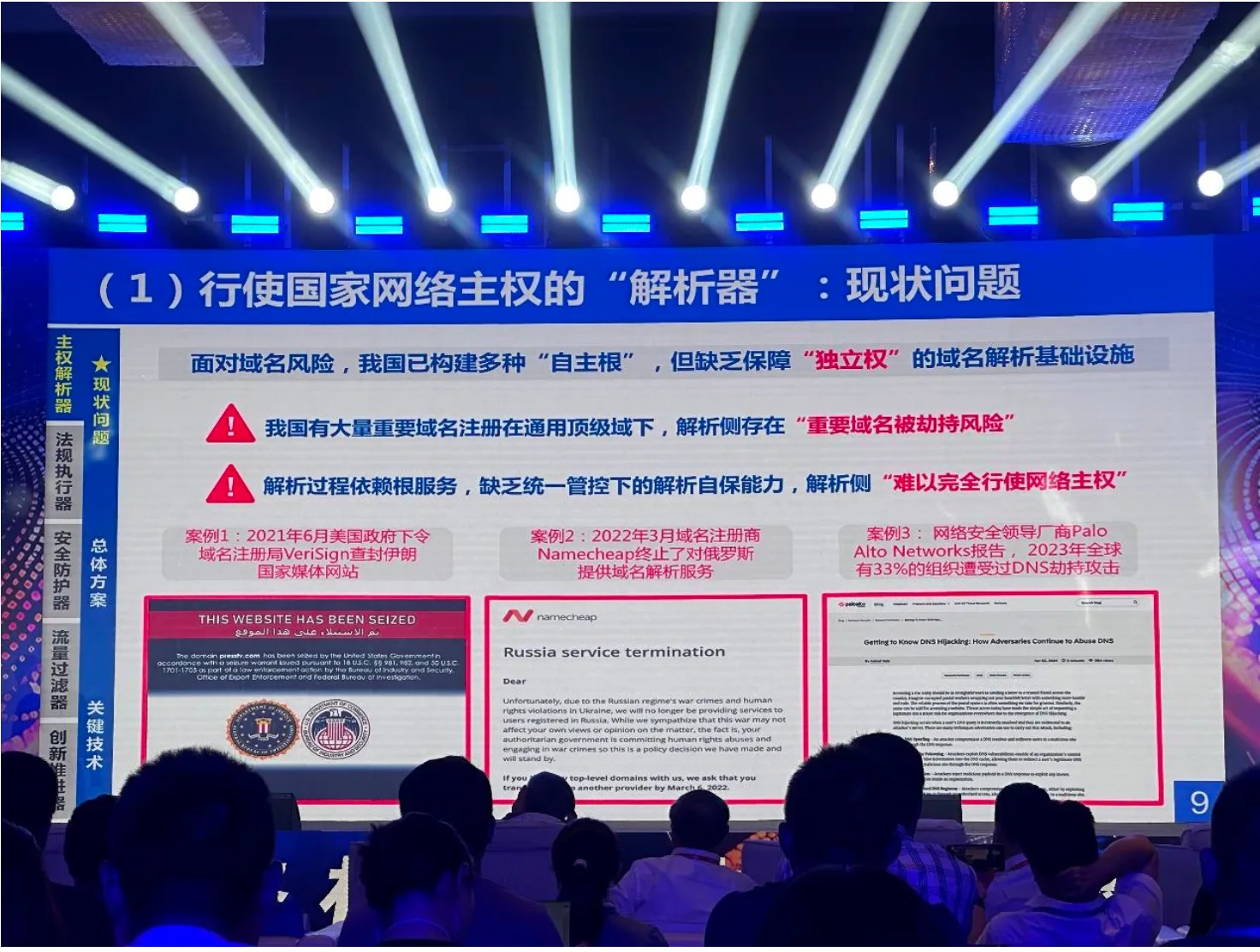
In the DNS4CN presentation, Fang is not just showing a theoretical risk of takedown based on current events. He is using the takedown examples as an argument for why China needs its own root.
Fang had been arguing for an autonomous national root since at least 2014, when he framed it in terms of national cyber sovereignty (国家网络主权).3 A 2017 paper he co-authored at Harbin Institute of Technology laid out the full architecture4: 国家根 (country roots) joined into a 根联盟 (root alliance), the direct ancestor of DNS4CN’s 创新根/联盟根. That paper named the exact risks the later takedowns would demonstrate, the “disappearance” of a ccTLD from the root and the “blinding” of a country’s resolvers, years before Iran and Russia made them concrete. The named DNS4CN program then traces through MESA’s encrypted-DNS measurement work (2020) to the first explicit proposal at CNCC in December 2022. Iran and Russia vindicated a position that PRC academy research had been interested in for close to a decade.
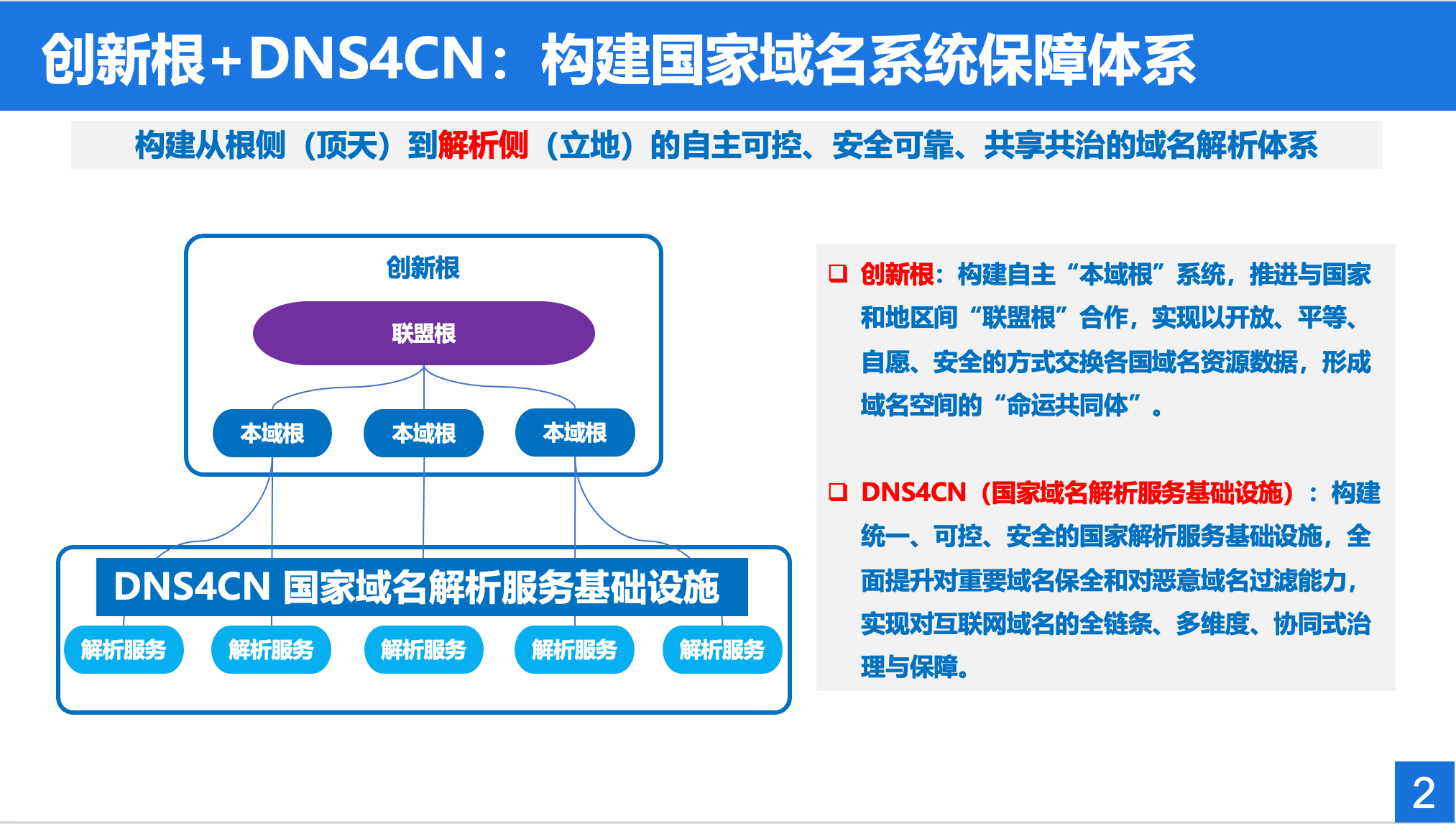
The 创新根/联盟根 is the long game. The near-term mechanism lives on the resolution side, in 域名保全 (domain preservation).
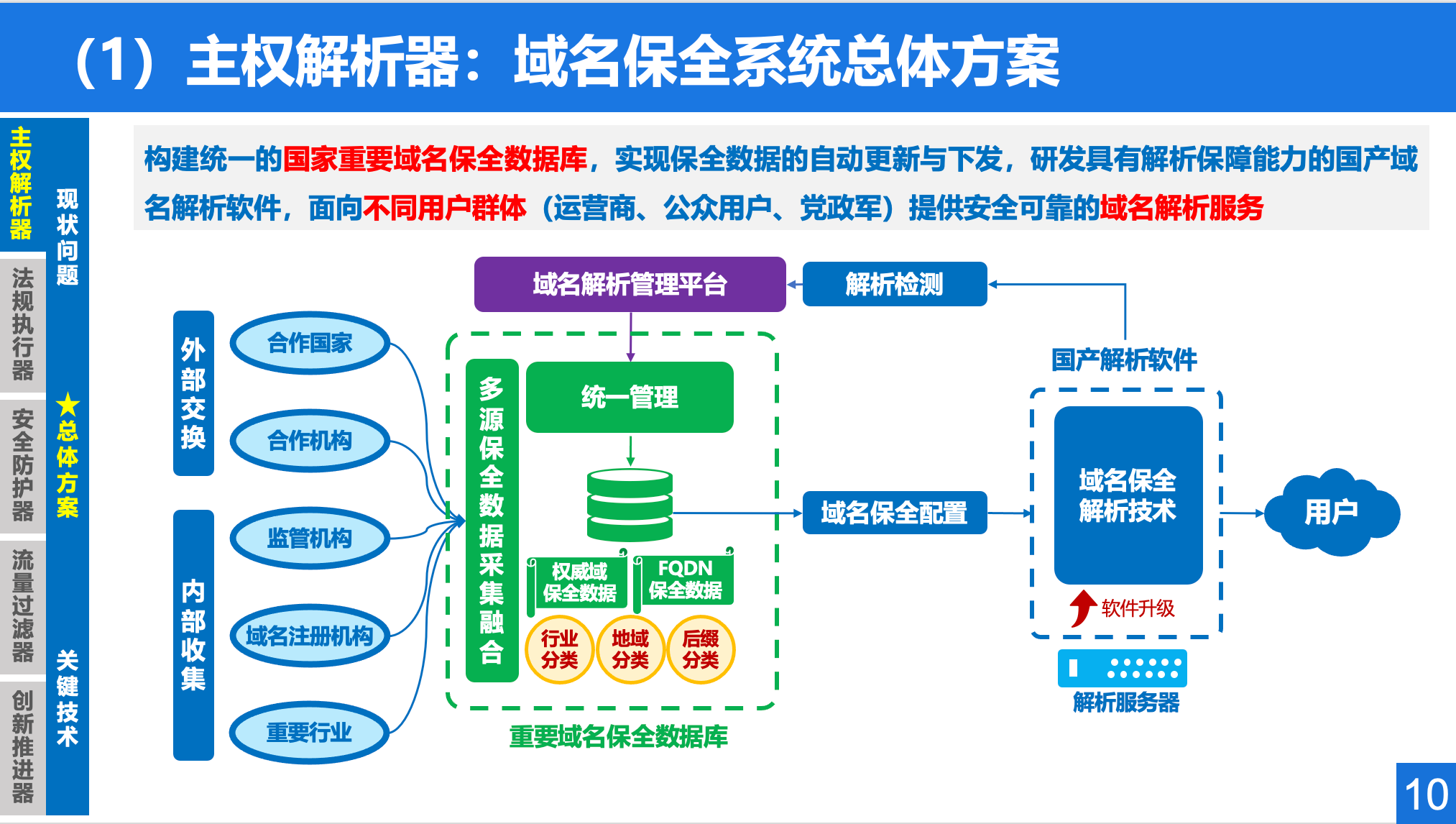
A foreign registry can revoke a Chinese domain and the domestic resolver keeps answering as if it never happened. That much is built and documented. The ceiling above it is not.
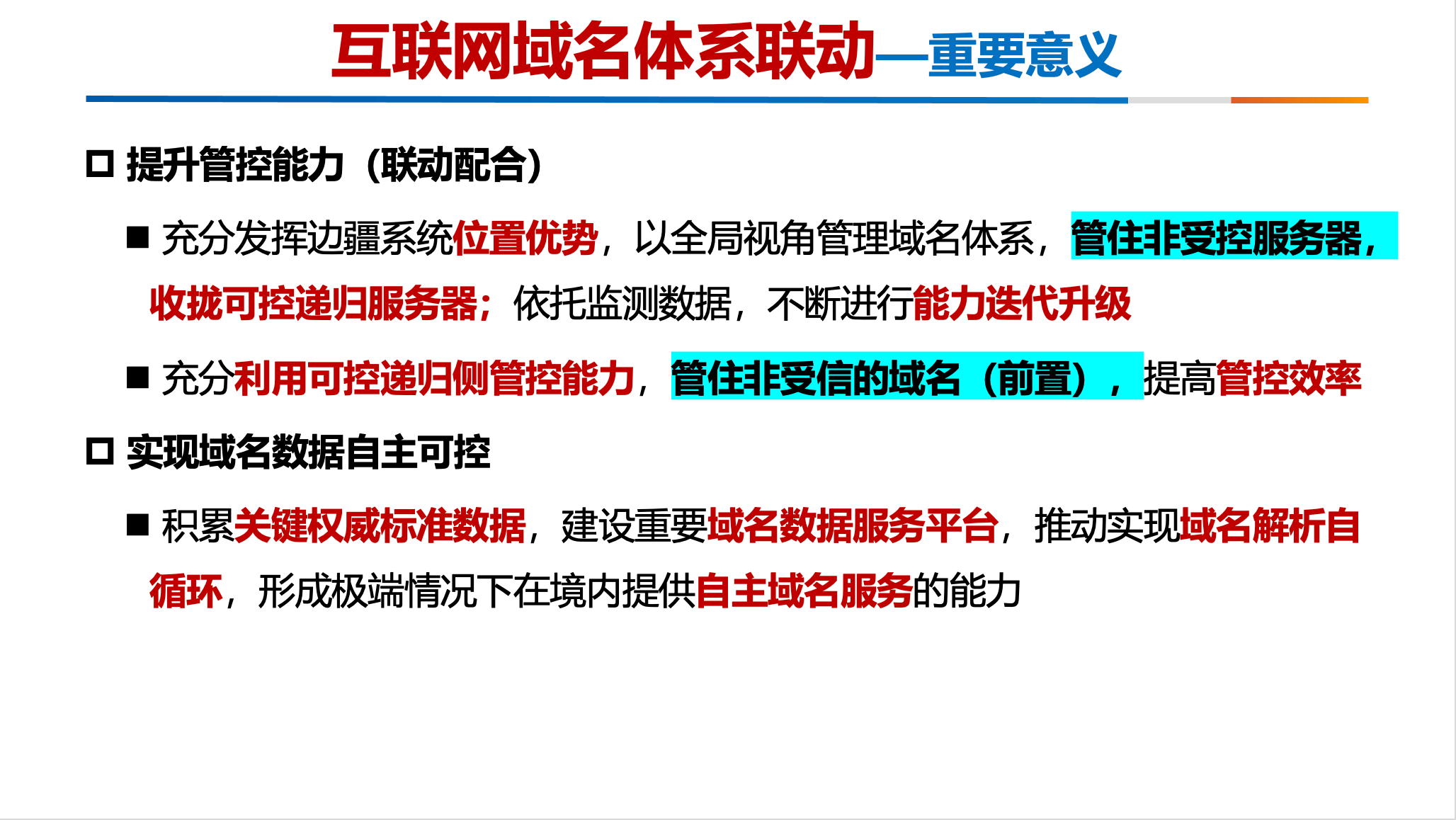
Self-circulation (自循环) is a domestic namespace that keeps resolving when severed from the global root. The verb is “push toward.” It is a target, not a demonstrated capability.
Even though the technique is not demonstrated, there is some lineage from IETF proposals. RFC 7706 (2015), updated by RFC 8806 (2020) describes running a local copy of the full root zone on the resolver itself, so it answers from its own root copy instead of querying the IANA root servers. The IETF version is deliberately narrow: the local copy must match the real root, gets validated by DNSSEC, and serves only its own host, so it cannot hand altered answers to anyone else. 自循环 keeps that architecture and flips the intent, from a faithful mirror built for latency and snoop-resistance to an autonomous root that can keep resolving (and, through 域名保全, resolve differently) once cut off from ICANN. The honest caveat: even the faithful loopback design is barely deployed and the IETF itself split on whether to recommend it, so China’s sovereign extension sits well beyond anything fielded.
The operational and ideological aims are consistent with current Xi thought on cyber-security power. In the compiled volume on Xi Jinping’s cyber-power ideology (Chapter 5, “Building a Durable National Cybersecurity Barrier,” translated by Dakota Cary5), Xi puts the root strategy in plain terms: “The root of the Internet is technical protocols, and the root of technical protocols is standards. Whoever sets the standards has the right to speak; whoever controls the standards has the commanding heights.” He adds that the contest is, in the end, about the right to set standards and the right to set rules. DNS4CN is an example of doctrine rendered as infrastructure. The same chapter sets the frame Fang is building toward, that without cybersecurity there is no national security, and instructs planners to “move the management gate forward” and build a strong data security barrier, which is what a national resolver does at the naming layer. Beijing wraps the alliance root in the language of a “community of shared destiny” (命运共同体), open and equal and voluntary, the same vocabulary Fang borrows from the Western protective-DNS programs he cites as precedent. It dresses a sovereignty-partitioned root in the language of cooperation.
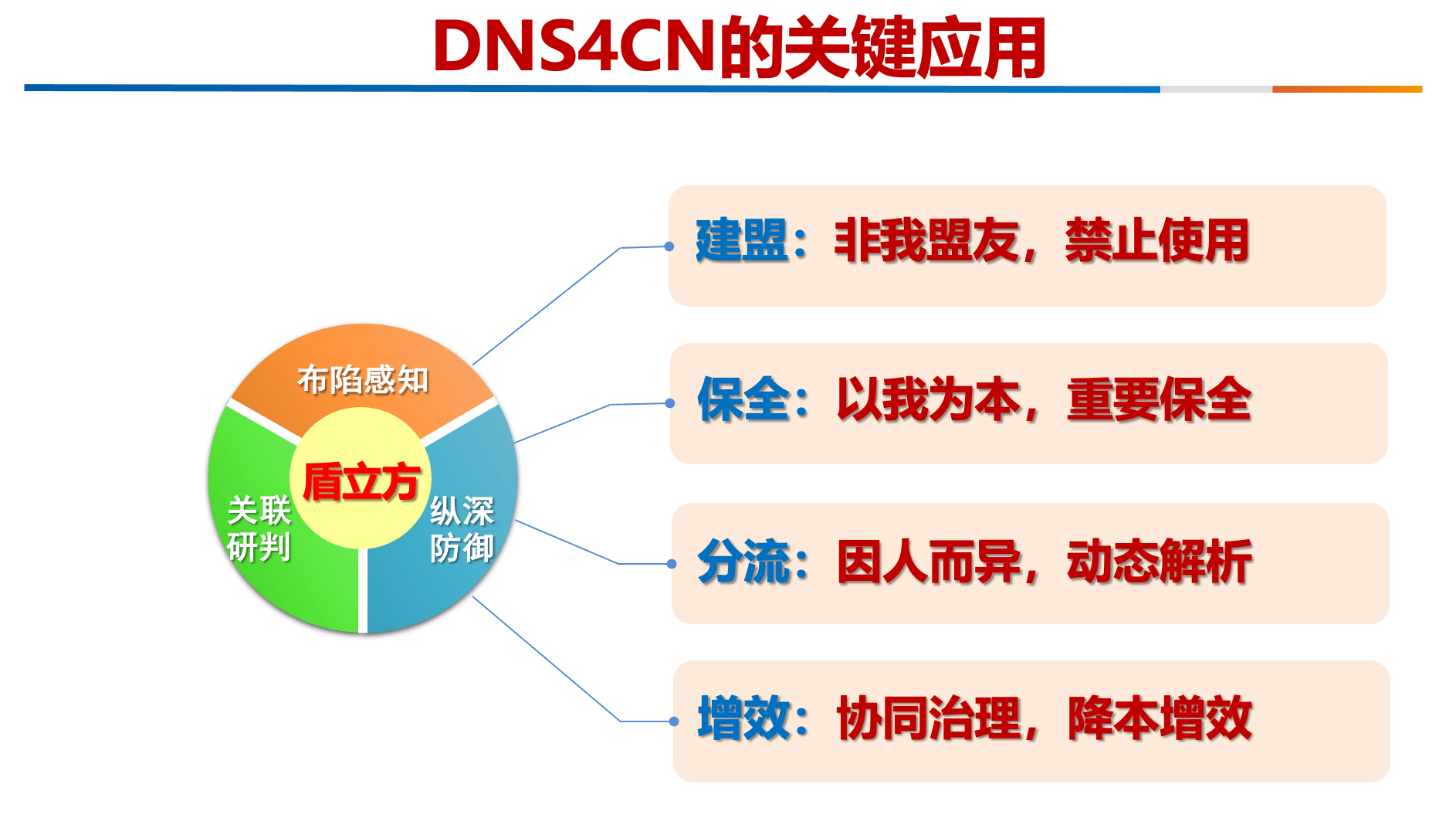
In my research, I have not been able to identify who joins the alliance root, the governance, or the real world implementation. The latter would be a good candidate for further study as Shield-Cube’s operational status is not known.
KJ3 — Encrypted DNS and the visibility deficit
So far I’ve discussed Resolver Consolidation (KJ1) and Deplatforming/Geopolitical insulation (KJ2), but how does China plan on enforcing this? What’s the baseline for DNS resolution in country today? Where do these queries actually go? A lot of them go dark.
MESA has a name for it: 逆差, a resolution trade deficit. From the national standpoint, domestic resolution goes invisible while foreign resolution stays visible (境内解析内容不可见,境外解析内容可见). This is not an opsec leak. Sovereignty over a network means seeing what crosses it, and on the encrypted-DNS layer Beijing has gone partly blind at home. The deficit is a visibility deficit, and MESA has been measuring how wide it runs.
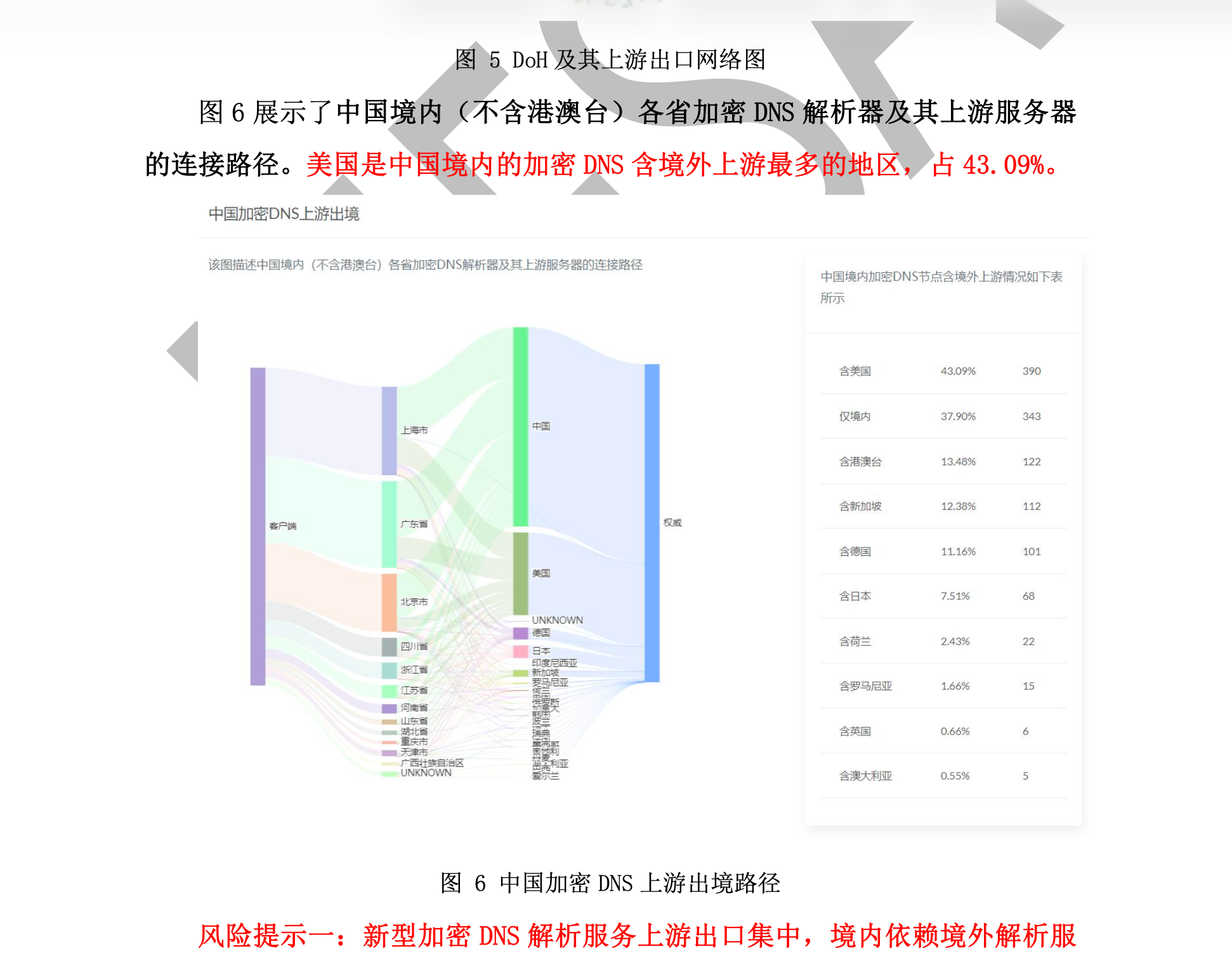
The sharpest number is also the most recent. In that report, 43.09% of China’s domestic encrypted-DNS nodes carry a US server somewhere in their upstream path, against 37.90% that stay entirely domestic. (Those are shares of nodes, with some overlap, so they are not mutually exclusive)
Around 20% of the upstream recursive resolvers Chinese forwarders depend on are foreign (Google, Cloudflare, OpenDNS). 24% of domestic DoH services route their upstream to foreign addresses. Only 7% of DoH nodes answer recursively on their own; the other 93% are proxies that decrypt the request and hand it to a public recursive resolver, often abroad. The lab’s complaint is consistent throughout: 底数不清, the base count is unclear, resolution the state cannot account for.
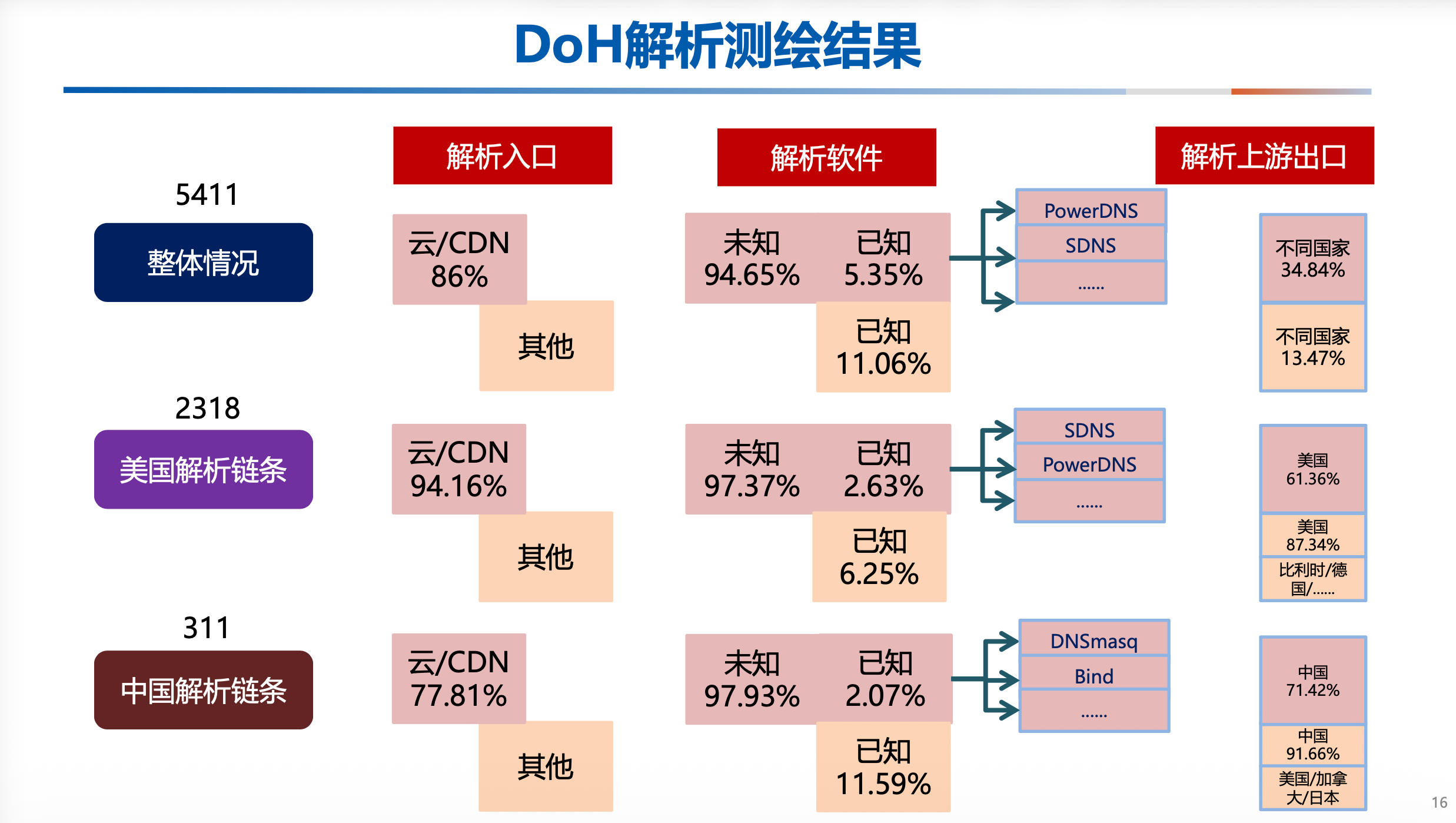
The asymmetry matters more than the totals. Both chains resolve most queries at home: the US chain keeps the large majority of its upstream egress in-country, and so does China’s. The difference is where the remainder goes. The US chain’s foreign tail lands in Belgium and Germany. China’s lands in the United States, Canada, and Japan.
Encrypted DNS is what makes this a sovereignty problem. DoH/DoT/DoQ encrypt the query so the state cannot read it, and by the lab’s own framing the same protocol is the censorship-evasion vector: Telegram defaults to DoH to route around ISP-level filtering (绕过ISP网络审查). So encrypted DNS does two jobs at once. It is the channel the resolution leaks through, and it is the hole in the Firewall (Try blocking port 443).
DNS4CN’s answer runs in both directions: pull the resolution home (尽可能本地解析, resolve locally wherever possible), and break the encrypted DNS that routes around the national resolver.
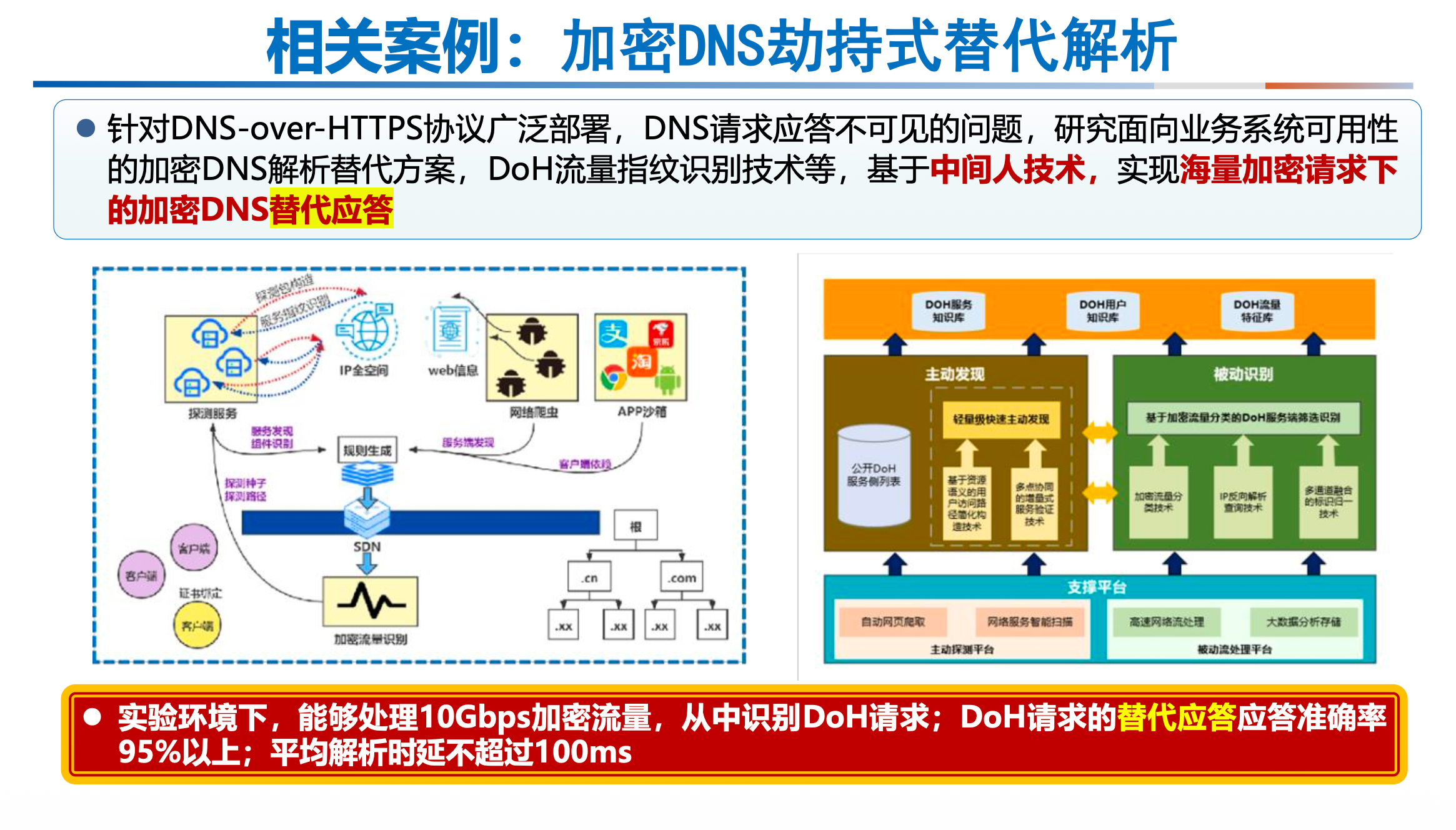
The decks describe two ways to break it, and they don’t sit at the same level of plausibility.
The first is disruption: detect an encrypted DoH session off-path (旁路监听阻断, bypass listen-and-block) and cut it (精确阻断特定会话, precisely block specific sessions). Off-path detect-and-reset is the Great Firewall’s existing playbook.
The second one (replacement response or 替代应答) is more aspirational and is why part of KJ3 is deployment unknown. Replacement response appears to be in a lab setting and it returns a forged answer. It does not diagram how the client accepts a forged answer over the session’s TLS layer. The only element on the whole slide that touches client trust is a small 证书绑定 (certificate-binding) node on the client side. That points to a lab setup that already controls what the client trusts, which fits the 实验环境下 label. The slide only references an experimental environment (实验环境下): 10Gbps of encrypted traffic, DoH requests identified within it, 95%-plus substitution accuracy, under 100ms added latency, funded as a CAS strategic pilot (中科院战略性先导专项).
The corpus shows intent plus a bounded lab demonstration, not deployment.
KJ3 is one number, two findings. The visibility deficit is measured and current: China’s resolution was still leaking to US upstreams in mid-2024, and the lab frames it as a sovereignty problem, not espionage. That half is high confidence.
The enforcement half is split. Off-path detect-and-block is real and already runs at the Firewall. Substitution is the reach: a line-rate MITM that forges DoH answers, but the slide shows a bounded lab demo that already controls client trust, not a system that defeats TLS in the wild. Designed intent, deployment unknown.
Resolve at home, see everything, overwrite what tries to leave. The deficit is the problem the state measured; the resolver is the answer it is building. Whether or not it is plausible to break or intercept TLS at scale is an open question.
Conclusion
DNS4CN is one system, and the leak lets you see all of it. Fang frames five functions in his ZDNS keynote; for a foreign observer, three matter. It consolidates China’s 700,000-plus resolvers into a single platform that logs every query against an identity, turning a fragmented censorship layer into a unified one (KJ1). It builds a root China can keep running when the global one is turned against it, an Innovation Root and a federated alliance root that hedge against the deplatforming Fang has been warning about since 2014 (KJ2). And it attacks the visibility deficit from both ends, pulling home the queries that go dark and breaking the encrypted DNS that carries them out, with a proposed man-in-the-middle substitution capability that has no Western equivalent (KJ3). Consolidation, insulation, control. The slides call all of it protection.
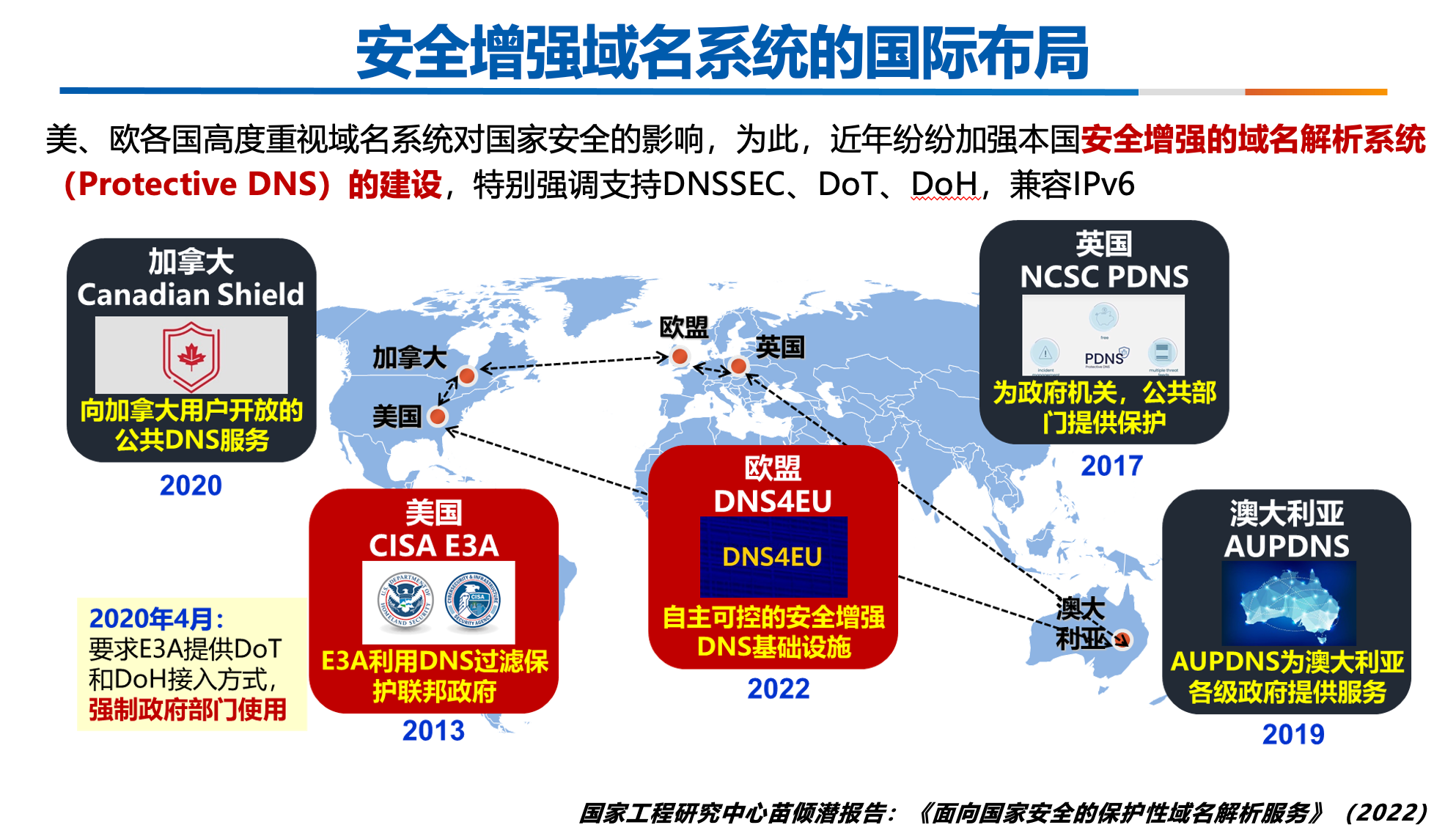
Fang and the IIE-CAS researchers model DNS4CN openly on the Western protective-DNS programs, US CISA, EU DNS4EU, UK NCSC, Canadian Shield, Australia’s AUPDNS, and lay them out on a map as the precedent (Fig 12). The vocabulary matches. The stated goals match security, abuse-blocking, sovereignty over a critical layer. One thing does not, and it is the whole difference.
Western protective DNS is something you choose. DNS4EU is a resolver you point your devices at if you want it; Canadian Shield is open to users who opt in; even the mandatory programs, CISA E3A and AUPDNS, are mandatory only for the government agencies they cover, not for the public. The protection sits at the edge, for the people and institutions that asked for it. DNS4CN sits at the center, for everyone, by default. It logs against identity, answers from a state-controlled namespace, and aspires to reach into encrypted sessions to overwrite what it cannot read. The same noun describes a service in Brussels and a mandate in Beijing, and the difference between them is consent.
A protective resolver and a sovereign resolver can run the same code and cite the same RFCs; what separates them is whether the user can say no. DNS4CN is built so that they cannot. Which returns to where this started: splitting the internet along sovereign lines no longer takes cutting cables. It takes a resolver, and control of what it resolves, and for whom.
Limitations and Acknowledgements
The biggest limitation of this post is my own lack of Mandarin ability. I manually reviewed large directories in the Geedge leak, then ran a keyword-based batch retrieval/RAG pipeline that surfaced 40 relevant documents out of a 100GB corpus. The keyword terms were a mix of my own and an LLM’s.
Some of those terms may not have been common or widely used, and I cross-checked against the Chinese transcripts where I could to mitigate that. There may also have been extraction or parsing issues with some documents (missing fonts, Unicode, or formatting problems) that kept them from being indexed or analyzed.
I want to thank the technical and language reviewers who looked over early drafts and the source material. A particular shoutout to NetAskari for the original DNS4CN post, and to Dakota Cary for his insights and translation work.
For readers going deeper: though not specific to DNS4CN, this net4people/bbs GitHub thread collects links to related analysis and media reporting.
-
NetAskari, “DNS4CN: A Truly Locked-Down DNS for China”, NetAskari on Substack. ↩︎
-
方滨兴 (Fang Binxing), “从’国家网络主权’谈基于国家联盟的自治根域名解析体系” [On a Country-Alliance Autonomous Root DNS Architecture from the Perspective of “National Cyber Sovereignty”], 信息安全与通信保密 (Information Security and Communication Privacy), no. 12 (2014): 35–38. ↩︎
-
Zhang Yu, Xia Zhongda, Fang Binxing, and Zhang Hongli, “一个自主开放的互联网根域名解析体系” [An Autonomous Open Root Resolution Architecture for DNS in the Internet], 信息安全学报 (Journal of Cyber Security) 2, no. 4 (2017), http://jcs.iie.ac.cn/ch/reader/view_abstract.aspx?file_no=20170405. ↩︎
-
Dakota Cary, trans., “General Secretary Xi Jinping’s Introduction to Important Ideology Regarding China as a Cyber Powerhouse, Chapter 5: Building a Durable National Cybersecurity Barrier,” CSIS Interpret: China, https://interpret.csis.org/translations/general-secretary-xi-jinpings-introduction-to-important-ideology-regarding-china-as-a-cyber-powerhouse-chapter-5-building-a-durable-national-cybersecurity-barrier/. ↩︎